


Special Events
-
OCT 13
-
OCT 13
-
NOV 10
-
NOV 10
-
DEC 08
-
DEC 08







Dangers of Lead
Lead can prevent a child from developing to his or her potential. Research has demonstrated that childhood exposure to lead at unsafe levels can cause learning disabilities, decreased growth, hyperactivity, and brain damage. In pregnant women, lead exposure can pass through the body to the unborn child and result in birth defects or miscarriage.
Lead may be found in dust, paint, glazed pottery or crystal from other countries, drinking water pipes and soil.
About Lead Poisoning
Lead poisoning is the condition of increased levels of lead in the blood. Lead is a natural occurring element that is used commonly in commercial & industrial products. People have small levels of lead in their bloodstream and it may cause no problems, but increased or prolonged exposure can result in lead poisoning. Lead poisoning is especially a concern for children under six years of age.
- Lead poisoning can cause damage to the kidneys, nervous system, and brain.
- Lead poisoning may also cause hearing, behavior and learning problems in young children.
- Once organ systems are damaged, the damage is often irreversible.
- Often lead poisoning goes undetected because the initial signs are similar to common ailments.
Steps to prevent Lead contamination in your home
- Taking shoes off when entering the home can keep lead dust levels to a minimum
- When opening windows, clean out dust and paint chips with wet wipes
- Wash children’s hands and toys often, to keep them from ingesting lead dust
- Old porcelain bathtubs and sinks are often coated with a lead glaze, have them re-glazed
- Antique cribs and other furniture were often painted with lead paint
- Baseboards and wood floors were painted with lead paint for durability
- Pottery, ceramics, and crystal often contain high amounts of lead
- Eating foods high in iron and calcium can decrease the amount of lead absorbed into the blood stream
- Replace all older vinyl mini-blinds, as they may contain high amounts of lead
- Avoid using the folk medicines, Greta and Azarcon to treat childhood illnesses
- Before refinishing furniture or stripping paint, be aware of the possible dangers and use proper safety measures and techniques
- Remove recalled toys and toy jewelry from children and discard as appropriate. Stay up-to-date on current recalls by visiting the Consumer Product Safety Commission’s website: www.cpsc.gov
Additional Information
Click here for more information on Lead Poisoning Prevention - opens in new window
Office Contacts
- Alyssa Underwood, REHS 812-282-7521 Ext 206
- Ashleigh Smith, EHS 812-282-7521 Ext 205
Radon is a colorless, odorless gas that has been linked to lung cancer. If you live in Clark County, there is some risk of radon gas exposure.
Radon comes from the natural radioactive breakdown of uranium in soil, rock and water and gets into the air. Radon can accumulate in enclosed structures like homes. It is estimated to cause thousands of deaths each year. The Surgeon General has warned that radon is the second leading cause of lung cancer in the United States. Only smoking causes more lung cancer deaths
 Is Radon a problem in Clark County?
In Indiana, close to 1 in 3 homes tested found elevated radon levels. Counties in Indiana are ranked as having a low, moderate or high potential for radon. Clark County is ranked as having the highest expected average radon levels.
Click here for a Radon Fact Sheet for Indiana
What should I do?
All homes in Clark County should be tested for radon. The US Environmental Protection Agency and the Surgeon General recommend testing all homes for radon. The quickest way to test is with short-term tests. Tests remain in a home for one to three days, depending on the device. Because radon levels tend to vary from day to day and season to season, a short-term test is less likely than a long-term test to tell the year-round average radon level. If results are needed quickly, a short-term test followed by a second short-term test may be used to decide whether to fix a home. Long-term tests remain in a home for more than 90 days. A long-term test will give a more accurate reading that is likely to be closer to the home's year-round average radon level than a short-term test.
Radon problems are not usually costly to fix. In most cases, vent pipes and fans are used to lower the radon levels in a home. A new home can be constructed to be "radon proof", and will add about $300-$500 to the cost of a newly constructed home.
Radon Certified Mitigation Specialists
For more information about radon and certified mitigation specialists in your area please visit the Indiana Department of Health Radon Information webpage
More Information on Radon
Click on the links below for additional information about radon:
- American Lung Association Radon Testing Kits
- U.S. Environmental Protection Agency (EPA) Office of Air and Radiation Radon Page
- National Radon Safety Board (NRSB)
- IDEM Radon Awareness Information
 Mold is found all in all parts of our lives. Most molds are not hazardous to healthy people. However, too much exposure to certain molds may cause or worsen conditions such as asthma, hay fever, and allergies. It is important to remember that these symptoms may not be caused by mold in the home, but possibly by another underlying health condition. The health department encourages individuals experiencing respiratory or physical ailments to contact their physician to determine if mold or other health issues may be the underlying cause of your family members symptoms.
Currently, there are no EPA, State, or local regulations or standards for airborne mold contaminants. However, there are standards regarding plumbing, drainage, and other defects that may be causing mold in the home. To learn more about mold visit the Environmental Protection Agency Mold and Moisture webpage - opens in new window.
What to do for a mold problem
The best way to treat mold is to correct the underlying cause of the mold, so that the mold does not return. Typically, mold grows in moist environments, and is often caused by water damage, leaking plumbing, poor ventilation, condensation, high humidity, etc. If you suspect that you have excess moisture or mold in your home or apartment visit the EPA's "A Brief Guide to Mold, Moisture, and Your Home - opens in new window" for information about how to identify, remove, and correct conditions that may be causing mold in your home, apartment, or business.
Indoor Air Quality Testing
You may also download and print our list of indoor air quality testing companies for Southern Indiana - opens in new window. This list is provided as a public service, however, the Clark County Health Department does not in anyway endorse or recommend any company or any service provided by any company. In addition, testing can be cost prohibitive and focusing resources on removing mold and correcting their causes could be a better investment.
Healthy Housing
Have a plan: Home fire safety
- Use this flyer to chart your smoke detectors & fire escape plans - Opens in new window
Mercury Containing Items and Mercury Spill Cleanup
-
Learn more about Mercury spills in the home - Opens in new window
Additional Information
All documents open in new windows
- Indiana State Department of Health Indoor Air Quality
- Centers for Disease Control Mold Facts
- Home Injury Prevention
- Healthy Homes Checklist
Bed Bugs
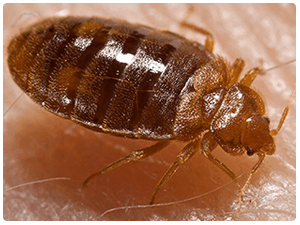 Bed bugs, Cimex lectularius, reddish-brown, oval-shaped, flattened insects that are about 1/4 inch long. Nymphs (immature bed bugs) resemble the adult bugs but are often smaller and lighter in color. Bed bugs usually feed on the blood of humans during the night-time hours and crawl away to hide in nearby cracks, crevices and recesses of furniture (especially mattresses) and walls of the home during the day. Most people experience itching, pain and/or swelling of the skin where a bed bug bite occurs (such as the arms,face or back) within 1 day of a bite. Although the bites can cause considerable discomfort and loss of sleep, bed bugs do not transmit disease after feeding on multiple hosts.Bed Bug Guide
Click here for more information about Bed Bugs - opens in new window
Image Attribution: By Content Providers(s): CDC/ Harvard University, Dr. Gary Alpert; Dr. Harold Harlan; Richard Pollack. Photo Credit: Piotr Naskrecki - http://phil.cdc.gov/phil/details.asp?pid=9822, Public Domain, https://commons.wikimedia.org/w/index.php?curid=2119254
Prepare Your Home for Bed Bug Treatments
Click here for tips for preparing your home for service treatments - opens in new window
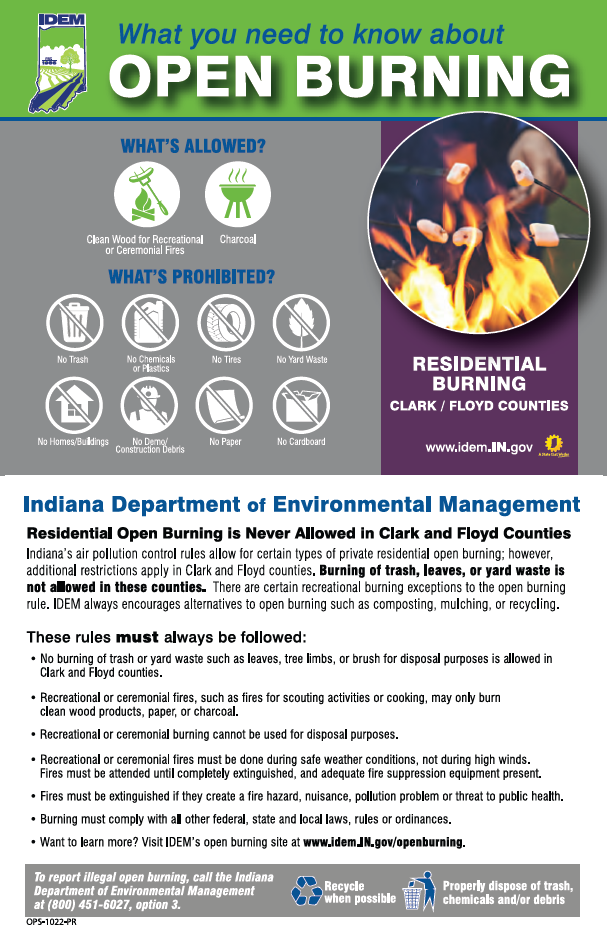 Please Note: Indiana rules generally prohibit open burning except for certain exceptions and Indiana Department of Environmental Management (IDEM) encourages alternatives to open burning - opens in new window. Open burning is the combustion of any matter in the open or in an open dump.
You may submit an application seeking approval from IDEM to engage in open burning if there is a need to burn waste.
Click here for more information on Open Burning Rules and Regulations - opens in new window
General Open Burning Guidelines (where permitted):
Open burning is generally not allowed in Clark County, especially if the materials to be burned include solid waste.
If you have questions whether the materials you wish to burn or if the location you wish to burn is permissible, please visit the IDEM Open Burning Information Page - opens in new window for current regulations.
If you are permitted to open burn please follow IDEM's guidance, inform the Clark County Health Department at 812-282-7521 prior to the burn event, and most importantly be safe!
For a general guidance for open burning in the State of Indiana, download a Open Burning Pamphlet - opens in new window from IDEM.
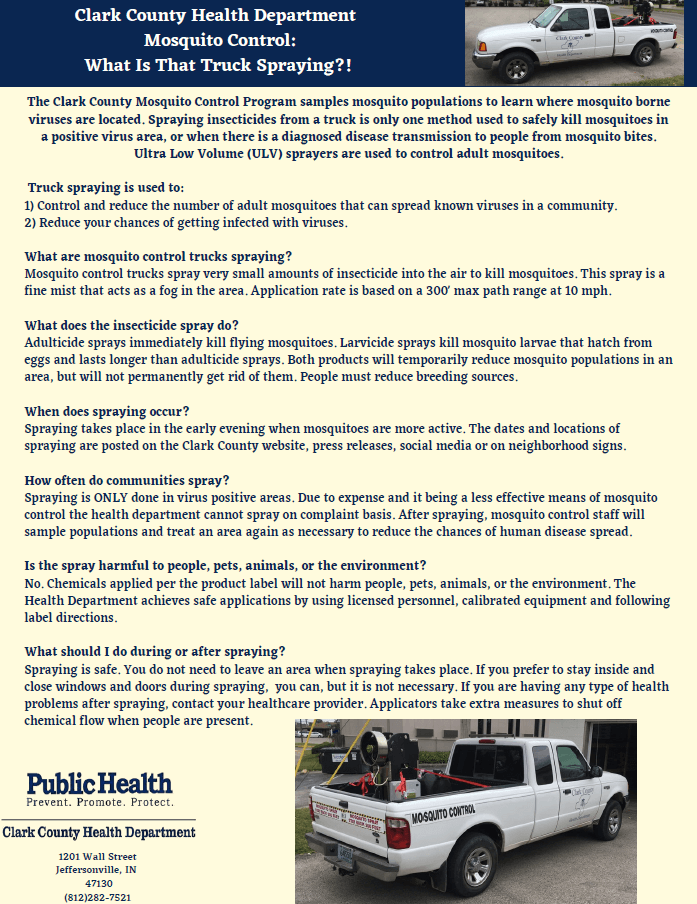 The Clark County Health Department is dedicated to controlling the mosquito population of the County. If you are experiencing a high number of mosquitoes in your area, please call the Clark County Health Department to report areas having standing water for more than 3 days. Please contact our office with this information at 812-282-7521.
How Are Mosquitoes Treated?
The Clark County Health Department is utilizing a number of methods to reduce the mosquito population in Clark County. Staff are currently using a "green" product that does not contain an organophosphate base that could be associated with environmental consequence. All of the treatments done by the Health Department are larvacides, these are a type of pesticide that prevents the larvae of mosquito from developing into biting adults. This method is preferred because millions of larvae can be stopped at the breeding site and the breeding site may be eliminated if possible. The best method for control is source reduction, most homeowners have potential breeding sites on their property and may not realize it, to learn more about mosquito breeding sites click here.
Visit the Indiana State Department of Health for more general information about the status of mosquito populations in Indiana.
Mosquito Surveillance Program
The mosquito control program also includes a surveillance program that monitors where specific types of mosquitoes are found and through testing what diseases they are carrying. The Clark County Health Department tries to set various traps in each township of the county throughout the mosquito season, the mosquitoes are collected, identified, and tested for diseases. Although all mosquitoes bite and can be annoying, not all carry disease. This fact allows the department to treat areas with increased risk (determined by trapping), and use limited pesticide budgets more effectively.
Additional Information
Links open in new windows
The Clark County Health Department requires that most restaurants apply and obtain a Food Service Permit prior to operating a food service in Clark County. There are several Federal, State, and local requirements involved in opening and operating a food service in Clark County. This office encourages a retail food operator to contact the Clark County Health Department as early as possible to ensure the smooth development and eventual operation of your facility. The environmental staff at the Clark County Health Department are here to help you navigate and understand the rules that govern food safety. For a general outline of the process of permitting in Clark County click on Food Service Permit, for additional assistance please call our office at 812-282-7521.
Food Handler Certification Examination and Training Program Providers
During the 2020 legislative session, House Enrolled Act 1210 (HEA 1210) was passed, making changes to the law on which the Certification of Food Handler Requirements rule, 410 IAC 7-22, was based.
Indiana Code 16-42-5.2 was amended in the Indiana State Department of Health’s (ISDH) agency bill (HEA 1210) to be consistent with terminology used nationally by the food industry and to eliminate confusion over similarly named, differing levels of food handler training. The parts of the bill relative to “Certified Food Handlers” (CFH), now called “Certified Food Protection Managers” (CFPM), have been excerpted and is attached as Attachment A. Click here to view the full text of HEA 1210 - opens in new window.
Click here for a list of training and testing facilities - opens in new window available from the Indiana State Department of Health. This list or any company on this list is not an endorsement of the Clark County Health Department.
Retail food Establishments
The Indiana Department of Health has released the newest food Code, 410, IAC 7-26 - opens in new window. It is set to go into effect on April 16th, 2025. There will be a phased enforcement period and education through the end of the year. More information will be released on our social media pages and via email to the contacts that we have on file.
A Certified Food Protection Manager (Certificate valid for 5 years) is needed for Retail Food Establishments who do not fall under the following exemptions:
A Certified Food Protection Manager is not needed when the food establishment's food handling activities do not include the cooking of raw food of animal origin or are limited to one (1) or more of the following: (1) Heating or serving precooked foods. (2) Preparing or serving a continental breakfast such as rolls, coffee, juice, milk, and cold cereal. (3) Preparing or serving beverages or ice. (4) Preparing or serving packaged or unpackaged low hazard foods, including elephant ears, funnel cakes, cotton candy, confectioneries, baked goods, popcorn, chips and grinding coffee beans. (5) Providing prepackaged food in its original package.
Organizations which were exempt from having a Certified Food Handler continue to be exempt from having a Certified Food Protection Manager, although they may employ one or more Certified Food Protection Managers if they desire to do so.
Home Based Vendor
If you sell food to an end consumer in the state of Indiana, you are either established as a Retail Food Establishment or a Home-Based Vendor. Most individuals who sell goods at farmer’s markets or roadside stands are operating under home-based vendors laws. Indiana passed a 2022 law (HB 1149 - Opens in New Window) which includes changes that will impact all persons operating as a home-based vendor. This article will help you understand who qualifies as a home-based vendor, which foods home-based vendors are allowed to sell and what has changed in the new law.
All home-based vendors are required to obtain a Food Handler Certificate from a certificate issuer that is accredited by the ANSI. Upon request, the home-based vendor must provide a copy of the certificate to the state department or end consumer. This certification is valid for three years. A home based vendor shall provide a copy of the food handler certificate required by subsection (a) to the local health department in the county where the home based vendor's residence is located.
Who is a home-based vendor?
Pursuant to code: IC 16-42-5.3 - opens in new window, “A home based vendor shall prepare and sell only a food product that is:
- made, grown, or raised by an individual at the individual's primary residence, including any permanent structure that is on the same property as the residence;
- not a potentially hazardous food product;
- prepared using proper sanitary procedures;
- not resold; (e.g. you must sell to the end user not someone who intends to resell; if you did this you must be licensed as a wholesaler).
More information on Home Based Vendors
- Food Protection Guidance Documents - opens in new window
- Food Protection Home Based Vendors FAQ - opens in new window
Protocol for Opening a New Food Establishment
Retail food establishments are required to submit a plan review (detailed drawing or schematic) to the Clark County Health Department regardless of whether building a new facility or remodeling an existing structure. There are state and local regulations that may affect the facility design and/or construction. To verify compliance with these regulations apply your facility designs to 410 IAC 7-26 and the Clark County Sanitary Code.
Once you have reviewed these documents, follow the bullets below to guide your submittal.
-
Confirm your state approval or apply for approval by contacting the Indiana Department of Homeland Security.
-
Submit state approved plans to the Clark County Health Department for plan review at least 6 weeks prior to opening.
-
Submit your plans, spec sheets, equipment cut sheets, Application for Plan Review, Plan Review Packet, and Food Service Permit Application with applicable fees listed on the application. These fees must be paid at the time of plan submittal.
-
Your plans will be submitted to an Environmental Health Specialist for review. After which, a letter approving plans or requesting revisions will be sent to the owner and/or architect.
-
After plans are approved you must pay for your Food Establishment Permit. The fee amount depends on the menu type as as defined on the application and fee schedule.
-
After all approvals and permits have been granted, please contact your designated Environmentalist to schedule a pre-opening inspection. This inspection will help you prepare your establishment for the scheduled opening and greatly reduce potential critical issues. This inspection shall be conducted at least 1 week prior to opening.
-
The final step is the opening inspection. This inspection should be conducted on your opening day or during the preparation for a V.I.P. or staff celebration prior to opening of the facility to the public. Food handling techniques will be assessed, food temperatures will be taken, and any final questions you may have will be addressed. If no critical violations are found, you will be issued a Food Service Permit. This permit must be displayed in public view. In addition, your facility may be required to obtain a "certified food manager", to determine if this will be required of your facility.
-
After opening, you should regularly consult your Health Inspector for any questions that may arise. The Clark County Health Department will make efforts to inspect the facility based on risk assessments. Additional inspections may be necessary if complaints are filed with the Health Department.
-
A copy of the 410 IAC 7-26 is required to be maintained or located in the food service establishment, this document maybe kept electronically, downloaded from the Indiana State Department of Health or purchased as a bound book at Budget Print Center in Jeffersonville, IN for a nominal fee.
Retail Food Service Permits
Click here to download a Retail Food Establishment and Mobile Food Permit Application
Click here to download a Temporary Food Service Establishment
Most food services in Clark County are required to have a Food Service Permit. If you intend to operate a food service establishment then you must apply for a permit through the Clark County Health Department. For a guide to opening a permanent (fixed site, farmers market, catering, or mobile) food service establishment click on Protocol for Opening a New Food Establishment.
Temporary Food Service Permits
A temporary food service would consist of a food establishment that will operate no more than 30 days in a calendar year in a non-fixed facility, such as those found at fairs, festivals, and other short term events like customer appreciation days and grand openings. The conditions for food preparation at these venues are less than ideal, but there are safe food practices that help create a safe event for both vendors and the general public.
Application for Temporary Food Service Establishment
General Guidelines for Temporary Food Service Brochure
Temporary Food Establishment Checklist
Please Note: Applications should be submitted at least one week prior to the day of operation.
Establishments Exempt From Permitting
Some food services are exempt from permitting and regulation. The rules and guidance links listed below may help determine if the food service you propose is exempt from permitting and inspection. However, some of these exemptions still require notifying the Clark County Health Department of the food service and may require submitting basic information for complaint and foodbourne illness investigations. Therefore, this office highly encourages contacting our office and speaking with an environmentalist to ensure that your facility is exempt and to register with our office.
The Health Department will be unable to perform inspections for exempt establishments even if you request an inspection, however, we can provide general advice and counseling about proper sanitary and food safety concerns you may have regarding your food product.
Additional Information
Documents open in new windows
- Commercial On-Site Sewage Disposal System Procedures
- Food Handler Certification and Training Program Providers
- Food Security Preventative Measures Guidance
- Operator Response to Inspection
- Sample Employee Health Policy
- State Variance Request Form
Información del Código Alimentario Español
Los documentos se abren en una nueva ventana.
- FAQ's - Allergens
- FAQ's - Bare Hand Contact
- FAQ's - Big 6
- FAQ's - Consumer Advisory Statement
- FAQ's - Person in Charge
- At a Glance - 410 IAC 7-26
- Food Facility Self Inspection Checklist
Restaurant Inspections

The Clark County Health Department inspects permitted facilities in Clark County based on risk assessment, complaints, and general rule compliance. Inspections are available for public view in person at the Clark County Health Department, by email, or please fax a written request, and a copy of the requested inspections will be provided. Letter grades are not assigned in Clark County, inspections detailing specific violations of the Indiana State Food Code and the Clark County Sanitary Code are written and corrective actions addressed.
Employee Health Policy Tool
The Food and Drug Administration (FDA) developed this Employee Health Policy Tool to encourage practices that can help prevent the transmission of foodborne viruses and bacteria in food establishments from ill employees. This tool will help users navigate restriction and exclusion requirements identified in the Food Code using clickable pathways dependent upon the role of the user and the symptoms and/or diagnoses presented.
Additional Information
Visit the Indiana State Dept. of Health website - Opens in New Window for more food related information.
 The Clark County Health Department has an environmentalist on call 24 hours everyday of the year to assist companies or individuals with emergency situations as it pertains to public health. The health department works with restaurants wanting to reopen after a fire, boil water emergencies, communicable disease reporting, and catastrophic natural and manmade events.
Other responses include any type of chemical spill that threatens to or has contaminated soils or waterways of the State of Indiana. In conjunction with the Health Department, the Indiana Department of Environmental Management - opens in New Window should be notified if there is a spill from any source. A representative of the Health Department will be available initially, but IDEM may arrive at a later point to assist in remediation efforts.
Reporting a Spill / Accident
If you need to contact IDEM to report a spill click here for list of IDEM emergency phone numbers - opens in new window. If you need to contact the Health Department after hours please contact the Clark County Emergency Management Office.
Hazardous Materials Spills after-hours emergency Line - 812-246-6996
If you have a spill that requires remediation, we have compiled a list of companies that have cleaned spills in the county previously - opens in new window. This list is not complete and the Clark County Health Department does not endorse any companies that may be on this list, these are providers that have responded to incidents in Clark County previously.