


Special Events
-
OCT 13
-
OCT 13
-
NOV 10
-
NOV 10
-
DEC 08
-
DEC 08






Click on the Grant Documents below to download the document.
| Name | Date added | |
|---|---|---|
|
HIV Prevention Grant
|
04/11/2023 | |
|
COVID-19 Vaccine Reimbursement Fund Grant
|
03/22/2023 | |
|
Greater Health Foundation Grant
|
12/05/2022 | |
|
Immunizations for Children
|
09/20/2022 | |
|
Co-Ag Grant Renewal
|
08/29/2022 | |
|
Overdose to Data Action Grant – Amendment
|
08/09/2022 | |
|
Health Issues and Challenges Grant - Lead
|
08/08/2022 | |
|
Public Health Emergency Preparedness (PHEP)
|
07/14/2022 | |
|
INDIANA AIDS FUND INC.pdf
|
06/15/2022 | |
|
Substance Abuse Prevention Treatment Block Grant.pdf
|
06/15/2022 | |
|
Strengthening Prevention and Control for Health.pdf
|
06/15/2022 | |
|
STD Prevention Program.pdf
|
06/15/2022 | |
|
RYAN WHITE PART B REBATES.pdf
|
06/15/2022 | |
|
Ryan White Part B Rebates - 9200.pdf
|
06/15/2022 | |
|
OVERDOSE TO DATA ACTION GRANT.pdf
|
06/15/2022 | |
|
Maternal Child Health Title V.pdf
|
06/15/2022 | |
|
Epidemiology and Laboratory Capacity for Infection Diseases.pdf
|
06/15/2022 | |
|
Cooperative Agreement for Emergency Response.pdf
|
06/15/2022 |
Please email your completed form to This email address is being protected from spambots. You need JavaScript enabled to view it. or fax to 812-288-2711 or you can drop off your completed form to the Health Dept office.
Click here to complete an official Indiana Animal Bite Form - Opens in New Window
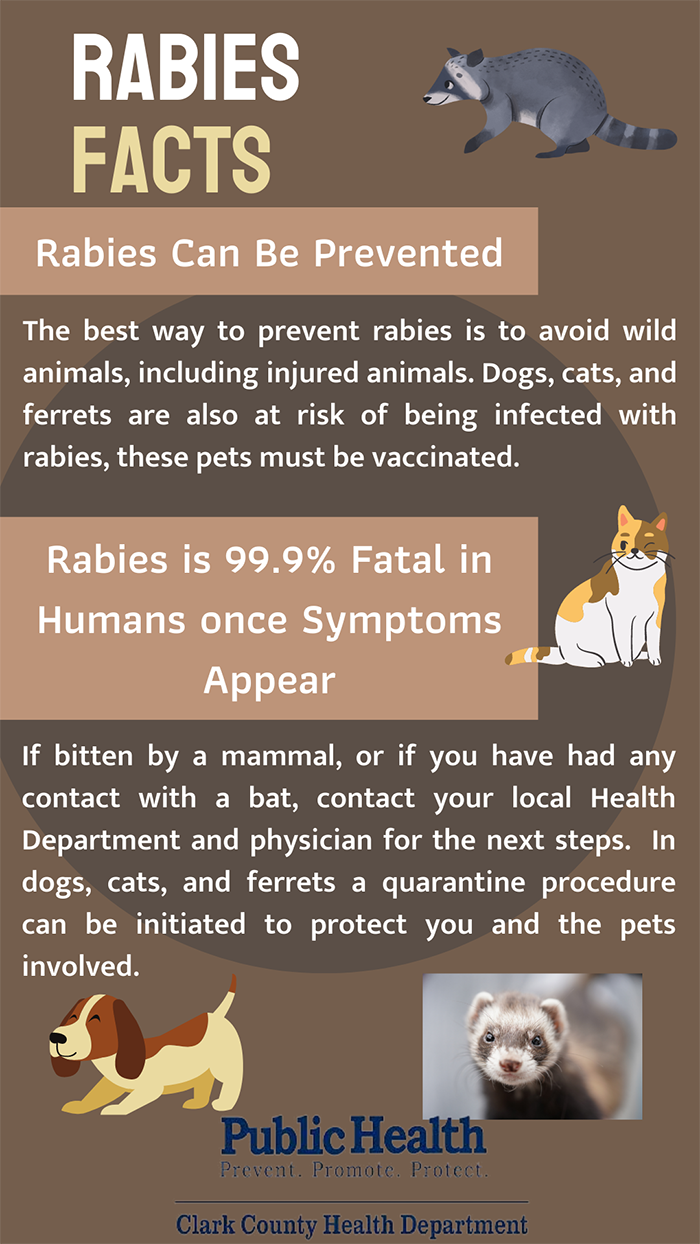 Animal bites can cause serious injury and infection, including rabies. Rabies is deadly in humans. All animal bites and exposures to bats should be reported to the Clark County Health Department.
Although rabies is rare in Indiana, it has not been completely eradicated. Indiana law requires all dogs, cats, and ferrets 3 months of age and older be vaccinated against rabies. To be recognized as valid, the vaccination must be administered by a licensed and accredited veterinarian.
Indiana animals considered to be at highest risk of transmitting rabies to humans include bats, skunks, foxes, raccoons, and coyotes. Dogs and cats can also transmit rabies that they have acquired from wildlife, but pets are rarely found rabid in Indiana. Reptiles and birds never get rabies. Theoretically, rats, mice, rabbits, squirrels, chipmunks, etc. can transmit rabies, but bites from these animals are not considered a rabies risk in Indiana at this time. Your local health department can help you evaluate the risk of rabies following an animal bite.
Rabies Frequently Asked Questions
Q: How do you treat an animal bite?
- A: Wounds should be washed and flushed immediately with soap and water for 10–15 minutes. If soap is not available, flush with water alone. This is the most effective first-aid treatment against rabies.
- A: Wounds should be cleaned thoroughly with 70% alcohol/ethanol or povidone-iodine, if available.
- A: As soon as possible, take the person to a healthcare facility for further treatment.
Q: How long does it take for dogs and cats to develop rabies, and how long does a rabid animal survive?
A: The incubation period ranges from a few days to several months, whereas the duration of illness – until death – varies from 1 to 7 days.
Q: How long after exposure do symptoms begin?
A: It may take weeks or months to get sick after exposure. This can vary depending upon the location of the bite, type of rabies virus, and any existing rabies immunity.
Q: What are the symptoms of rabies infection?
A: Early symptoms of rabies infection include fever, headaches, weakness, and discomfort, as well as a prickling or itching sensation at the site of the bite. Later symptoms include agitation, anxiety, insomnia, confusion, delirium, hallucinations, hydrophobia (fear of water), difficulty swallowing, drooling, partial paralysis, and eventual death.
Q: How is rabies spread?
A: The rabies virus is found in the saliva of infected animals. The virus is spread through a bite or scratch from an infected animal.
Keep bats out of your home:
Bats, mice, and other critters can fit through very small cracks, so sealing up gaps and cracks in your home is important.
Attics are often a favorite space for bats. There may be droppings where the bats have been living, and their entrance hole will likely not be far away.
Before entering an attic, be sure to cover yourself with protective clothing including an N95 mask. Bat or other animal droppings can carry disease, and many types of insulation can be unhealthy for your lungs and skin. Bring a flashlight into the attic. Move around the attic, turning the flashlight off to look for daylight coming in, which is where critters may be entering.
Bats or mice can also enter a home through the basement or crawl space. Once they get in, they can sometimes climb inside a wall from the basement or crawlspace up to the attic or into the house, so don't ignore gaps or cracks anywhere. Search other parts of your house as well. If you can see daylight through a crack, creatures can likely come inside.
Many stores sell cans of foam or tubes of caulk intended for sealing up cracks. Read all product labels, and follow instructions for safety and application instructions. It is best to seal small cracks at the inside surfaces of the house, which helps prevent interior humidity from escaping into your building structure and condensing, which feeds mold and mildew. To reach small cracks, tape a disposable drinking straw to the end of the straw that comes with the can of spray foam. Squeeze the drinking straw flat to reach small cracks. Let the foam harden and then scrape off or cut back any excess foam.
Large gaps in the outside of the house can be covered with metal flashing, which should be tucked under the siding or trim above. This allows water to shed off the house and humidity to escape the structure, while keeping critters out of your home.
Pest control companies are also available if the issue seems too big to handle on your own, or if these do-it-yourself methods are not effective. -HD of Washtenaw County Michigan
Related Information
- What to do if you have a bat in your home - Opens in New Window
- Indiana Rabies Information - Opens in New Window

The United States Department of Agriculture Rural Development program can assist very-low income homeowners with loans for repairs to improve properties. To determine if you would be eligible for a loan or grant to repair/replace a failing septic system or some other environmental or health hazard visit USDA Rural Development for more information and requirements.
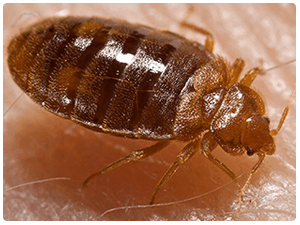 Bed bugs, Cimex lectularius, reddish-brown, oval-shaped, flattened insects that are about 1/4 inch long. Nymphs (immature bed bugs) resemble the adult bugs but are often smaller and lighter in color. Bed bugs usually feed on the blood of humans during the night-time hours and crawl away to hide in nearby cracks, crevices and recesses of furniture (especially mattresses) and walls of the home during the day. Most people experience itching, pain and/or swelling of the skin where a bed bug bite occurs (such as the arms,face or back) within 1 day of a bite. Although the bites can cause considerable discomfort and loss of sleep, bed bugs do not transmit disease after feeding on multiple hosts.
Bed Bug Guide
Click here for more information about Bed Bugs
Image Attribution: By Content Providers(s): CDC/ Harvard University, Dr. Gary Alpert; Dr. Harold Harlan; Richard Pollack. Photo Credit: Piotr Naskrecki - http://phil.cdc.gov/phil/details.asp?pid=9822, Public Domain, https://commons.wikimedia.org/w/index.php?curid=2119254
Prepare Your Home for Bed Bug Treatments
Click here for tips for preparing your home for service treatments
 Click on the link below to learn more about operating a food truck in Clark County Indiana.
Click here for a Food Truck Brochure - Opens in New Window
Mobile Retail Food Establishments
- Mobile Food Establishment Guidance Document - Opens in New Window
- Click here to download a Mobile Food Permit Application - Opens in New Window
1) The purpose of the Clark County Sanitary Code is to establish minimum sanitary standards for the protection, promotion, and improvement of public health, safety and welfare, and for the control of disease, which are consistent with the laws of the State of Indiana, regulations of any superior governmental administrative department or agency of the United States or the State of Indiana or any department or agency comprised of any combination thereof; and,
2) To maintain a sanitary environment; and,
3) To establish the procedure whereby the Clark County Board of Health can effectively and properly perform the duties required of it pursuant to the Public Health Code of Indiana, Acts 1949, CH. 158, I.C. 16-1-1, et.al, through I.C. 16-1-35, et-al.
Click here for more information on the Clark County Sanitary Code